When Summer Turns Dangerous: How Extreme Heat Silently Threatens the Elderly
By : Housepital, Published on : 17 Apr 2026
When Summer Turns Dangerous: How Extreme Heat Silently Threatens the Elderly
Every summer, as temperatures across India push past 40°C, most people reach for a cold drink and a fan. But for an elderly parent or grandparent living in your home, that same heat can quietly cross the line from discomfort into a medical emergency — often before anyone realizes it.
Heatwaves are frequently called a "silent disaster" precisely because the warning signs don't always announce themselves loudly. And the science is getting harder to ignore.
The Numbers Behind the Risk
The period 2013–2022 saw an 85% increase in heat-related deaths among people over 65 compared to 1991–2000 — substantially higher than the 38% increase that would have been expected from population growth alone, according to the Lancet Countdown 2023 report on health and climate change. *
Closer to home, India accounted for approximately 20.74% of all global heatwave-related deaths between 1990 and 2019, according to a study published in PLOS Medicine 2024*. And critically, even a single day of extreme heat can increase daily mortality by 10–25%, while prolonged five-day heatwave events can push this figure above 30%, according to a multi-city study published in Environmental International 2024*.
Perhaps most alarming for India's future: one in five Indians — 20% of the population — is expected to be over 60 years old by 2050, per the India Ageing Report 2023*. The vulnerable group is only growing.
Why the Elderly Body Is Different in the Heat
1. The cooling system degrades with age
Aging is not just about grey hair and slower reflexes — it fundamentally changes how the body handles heat. Systematic research shows that older adults exhibit reduced sweating, impaired cutaneous vasodilation, and attenuated cardiovascular adjustments to heat — all of which result in faster rises in core body temperature and greater risk of dehydration compared to younger adults.*
In plain terms: an elderly person's body simply cannot shed heat as efficiently, and it reaches dangerous temperatures more quickly.
2. Thirst — the body's own warning system — goes quiet
One of the most under-appreciated dangers is that older adults often don't feel thirsty even when they're significantly dehydrated. As people age, their sense of thirst can decrease — and so can their ability to sweat.* This creates a cycle of "silent dehydration" that weakens the body before any obvious symptoms appear.
3. Existing illnesses get worse
Heat doesn't act alone — it amplifies whatever is already wrong. Heart disease makes it harder to move blood to the skin, while diabetes can reduce both blood flow to the skin and sweat production — both of which are essential cooling mechanisms. * When those mechanisms are already compromised, extreme heat pushes the body further toward crisis.
4. Common medications become a hidden risk factor
This one surprises many families. Medications commonly prescribed to older adults — including diuretics, antidepressants, antipsychotics, and anticholinergics — can increase the risk of heat-related illness through multiple mechanisms: dehydration, electrolyte imbalance, reduced sweating, decreased thirst sensation, and changes in how the body regulates its core temperature. *
Non-selective beta-blockers like propranolol, widely prescribed for heart conditions, can result in greater impairments in thermoregulation than their more targeted alternatives, potentially predisposing patients to greater heat strain. * Even insulin, used by diabetic patients, has been shown to impair the body's heat regulation.
The takeaway: the same medications keeping your elderly family member stable year-round may be making them significantly more vulnerable every summer.
5. Heat affects cognition too
The brain is not spared. Epidemiological studies confirm that high ambient temperatures are significantly associated with increased hospitalizations and mortality among older populations — particularly at advanced ages and among those with existing comorbidities. *Confusion, irritability, and sudden behavioral changes during a heatwave are not "just old age." They can be early signs of heat-related neurological stress that require immediate attention.
The Symptoms That Get Missed
Heat illness in the elderly rarely begins with a dramatic collapse. It starts subtly — with dizziness, unusual fatigue, dry mouth, reduced urination, or mild confusion. Because these mirror the normal aches of aging, families tend to brush them aside. That delay is where the danger lies.
Research published in Nature Communications found that non-survivable heat conditions have already repeatedly occurred across major heatwave events worldwide — and older people face the highest risk due to their reduced ability to regulate body temperature.*
When heatstroke sets in — body temperature rising above 40°C, the cooling system overwhelmed — it becomes a medical emergency with a rapidly narrowing window for intervention.
What Families Can Do Right Now
Hydrate proactively, not reactively. Don't wait for thirst. Small, frequent sips of water, ORS, coconut water, or buttermilk throughout the day are far more effective than drinking large amounts infrequently. Experts note that drinking large amounts of plain water in a short time can itself be dangerous due to electrolyte imbalance risk — consistent, moderate intake is key. *
Cool the living space. AC, coolers, or fans with blocked direct sunlight make a measurable difference. If cooling devices aren't available, wet towels on pulse points (wrists, neck) help the body shed heat.
Monitor daily — don't wait for complaints. Check temperature and blood pressure. Watch for behavioral changes. An elderly person who "seems fine" may not be fine — they may simply not be registering their own distress accurately.
Restructure the day. Avoid outdoor exposure between 11 AM and 4 PM. Light, breathable cotton clothing is not just comfort — it's a functional cooling tool.
Review medications with a doctor before summer peaks. If your elderly family member is on diuretics, beta-blockers, or antipsychotics, discuss whether dosage adjustments or additional monitoring are warranted during extreme heat months.
Why Home Healthcare Matters More in the Summer
For elderly individuals, the act of getting to a hospital during a heatwave carries its own risks — physical exhaustion from the journey, prolonged heat exposure, and delays due to mobility limitations. Home healthcare bridges this gap by bringing monitoring and medical attention directly to where the patient is already safe and comfortable. The difference between a manageable situation and a hospitalization often comes down to how quickly symptoms are caught and acted upon.
The data is consistent and the science is clear: extreme heat is a serious, growing threat to India's elderly population — and one that is consistently underestimated. This summer, the most powerful thing a family can do is simply to pay attention, act early, and not mistake subtle warning signs for ordinary aging.
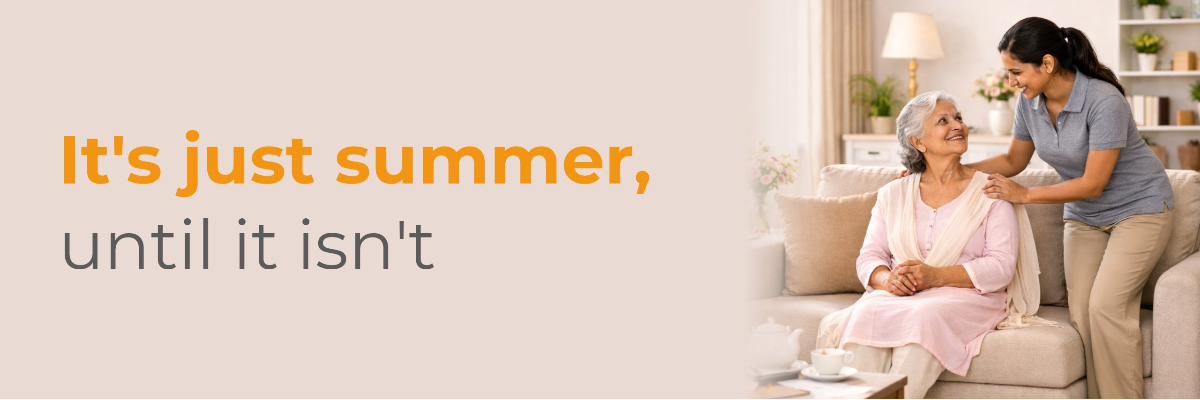
Because it's just summer. Until it isn't.
Sources:
-
Lancet Countdown 2023 Report on Health & Climate Change — thelancet.com
-
PLOS Medicine 2024: Global heatwave-related deaths — journals.plos.org
-
Environmental International 2024: Multi-city heatwave mortality in India — sciencedirect.com
-
India Ageing Report 2023 — unfpa.org
-
Preventive Medicine Research & Reviews 2024: Heat Stress in India — journals.lww.com
-
Nature Communications: Non-survivable heat study — nature.com
-
The Lancet Healthy Longevity 2022: Medications and heatwaves in older adults — thelancet.com
-
Pharmacological Reviews 2023: Medications and heat loss capacity — pubmed.ncbi.nlm.nih.gov
-
Yale Climate Connections: Medications and heatwave risk — yaleclimateconnections.org
-
Global Heat Health Information Network: India's heatwave mortality data — heathealth.info
Need care for a loved one at home?
Trained nurses, caregivers and physiotherapists across Delhi NCR.
Explore our services